
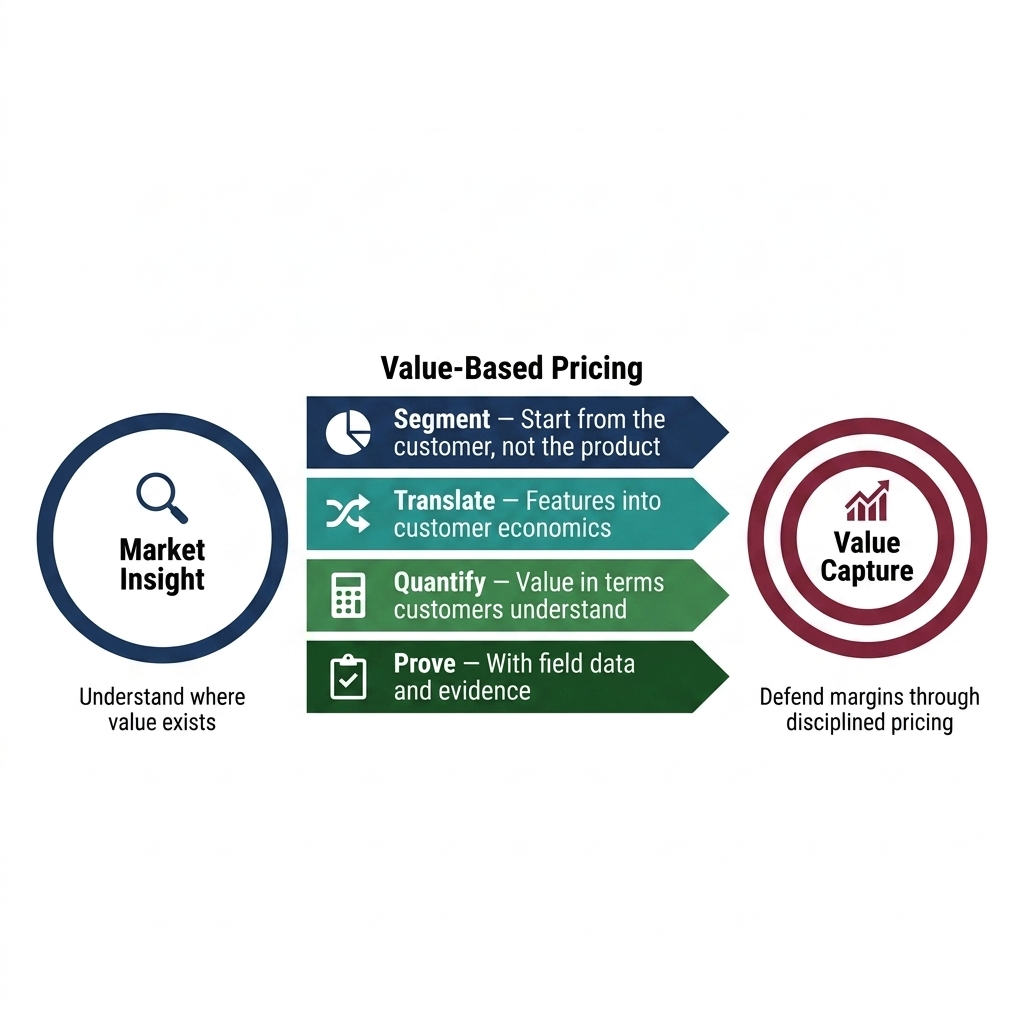
In our previous article, From Insight to Action: How Market Research Shapes a Better Crop Business Plan, we argued that a strong Crop Business Plan should not be built on assumptions, legacy logic, or internal enthusiasm alone. Precise market insight is needed to properly translate demand shifts, margin pressure, regulatory changes, and competitive moves into coordinated action. The article framed the Crop Business Plan around three essential questions:
What business should we be in?
How should we compete?
What should we avoid?
Following this logic, a fourth question naturally emerges:
How much of the value we create are we actually able to capture?
In many companies, pricing is treated as the final administrative step of a commercial plan. The product is developed, the market is selected, the positioning is defined. Only then does the organization ask: “What price should we put on it?”
In many cases, the answer still comes from cost-plus logic, competitor benchmarking, or historical price lists. These inputs naturally matter, since costs define the economic floor and competitor prices set the market context. But neither fully answers the central question:
What is this offer worth to the customer, in this specific use case, compared with the available alternatives?
Value-Based Pricing (VBP) brings pricing back into strategy. It connects market research, customer understanding, product differentiation, and commercial execution into one discipline: capturing a fair share of the value created.
What Value-Based Pricing really means
VBP is a pricing approach that sets price according to the value a product or solution creates for the customer, rather than only according to production cost or competitor price. In B2B markets, however, it should not be understood as simply “charging more.” Value is not always embedded only in technical specifications. It may also depend on where, how, when, and by whom the product is used. The same product can have very different values in different customer situations.
In crop businesses, this distinction is crucial. A variety, a biostimulant, a biological product, or a technical service does not create value in the abstract. It creates value under specific agronomic, climatic, operational, and commercial conditions. For one customer, value may mean higher yield. For another, more stable performance under stress. For another, reduced crop loss, better quality, lower labor intensity, or stronger reliability of supply.
This is why VBP’s structure grants a way to understand which value drivers matter, for whom, under which conditions, and how they can be quantified.
From product features to customer economics
A common mistake in agribusiness is to confuse technical features with customer value. A seed company may say: “This variety has improved resistance.” This statements may be true, but is not yet value argument. A value argument translates the feature into customer economics: “This resistance reduces the probability of crop loss in high-pressure areas.” “This resilience stabilizes performance under water stress, protecting marketable yield.”
This difference is fundamental, as it changes the sales conversation from what the product is to what the product enables. Research on customer value-based pricing has consistently shown that one of the main barriers to VBP adoption is the difficulty companies face in assessing, measuring, and communicating value. This is particularly relevant in crop markets, where value can be technically complex, seasonal, uncertain, and dependent on local conditions.
Where VBP fits in a Crop Business Plan
The Crop Business Plan helps a company decide where to focus and how to compete. VBP helps the company decide how to monetize that focus. The connection is direct: market research identifies where the customer recognizes enough value to support a differentiated price; unmet needs become measurable economic benefits; value drivers shape the commercial argument; and evidence from trials, field data, and customer cases builds the proof needed to defend the price.
This is why pricing should not be left to only one department alone. Breeding, regulatory, technical development, sales, marketing, and market research all see different parts of the value picture. If pricing is defined without that broader view, the risk is either to underprice valuable differentiation or to claim a premium the market does not recognize.
From insight to value capture
Market research helps companies understand where to compete. A Crop Business Plan translates that insight into strategic direction. Value-Based Pricing turns that direction into margin discipline.
For agribusiness companies, this connection is becoming increasingly important. Innovation cycles are long, development costs are high, market conditions are volatile, and customers are more selective. In this context, pricing cannot be an afterthought. The companies that succeed will not simply be those with better products. They will be those able to prove where their products create value, communicate that value clearly, and capture a fair share of it through disciplined pricing.
In that sense, Value-Based Pricing is not separate from market research, but one of its most important commercial outcomes: the bridge from insight, to action, to value capture.