
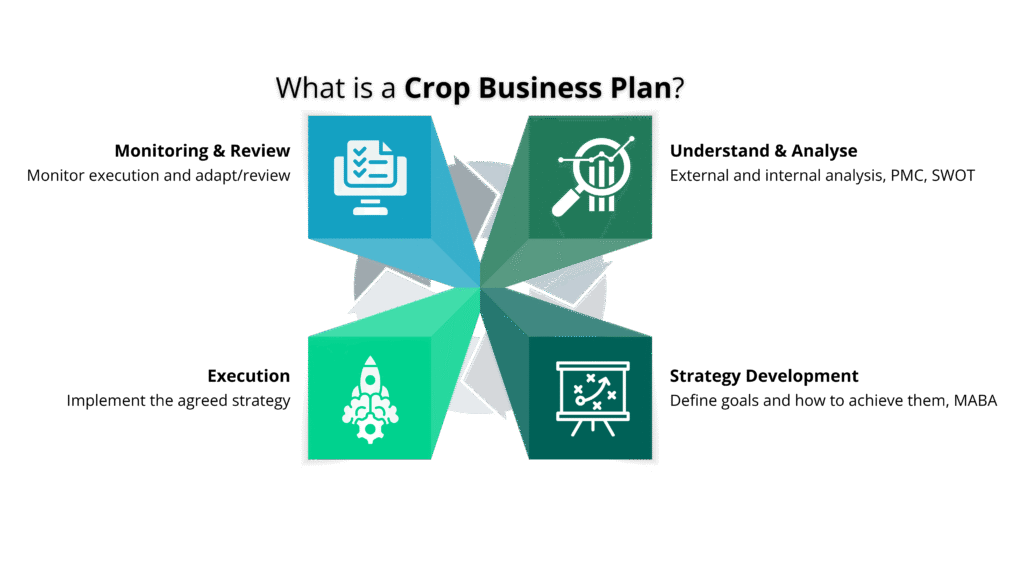
In Seeds business, a Crop Business Plan’s strength is directly proportional to its market insight efficiency.
In our experience, crop plans are often tainted by internal assumptions, past portfolio logic and historical momentum.
However, in a market shaped by changing consumer demand, tighter margins, climate pressure, evolving regulations, labor scarcity and faster-moving competition, precise updated data is a must, along with the ability to translate it into priorities and coordinated action.
That said, what is exactly a CBP?
It is a strategic tool that helps leadership decide where to focus, which opportunities to pursue, and how to compete in a given business. At its core, it is meant to create a unique and valuable market position, make the right trade-offs by choosing what not to do, and align company activities behind a coherent strategy. In portfolio terms, it forces two essential questions: What business should we be in? How shall we compete in this business?
The first step is external analysis by PMC: by product–market combination.
Rather than looking at a crop in general terms, the company evaluates a specific opportunity in a specific market context. That means understanding not only market size and growth, but also value, margins, customer expectations, competitor strength, technology shifts, freedom to operate, and the likely direction of the market over the next five to eight years. The original CBP material already points to the right questions:
Where is the demand? Where is it moving towards to? What customers value? How are competitors positioning themselves? Which technologies are changing the rules of the game? Which product–market combinations are gaining or losing attractiveness?
Answering these questions will determine whether a market is attractive because it is growing or because competitors are poorly positioned, as well as identifying commoditization issues, pricing pressure and/or regulatory risks that may weaken attractivity.
Once this step is cleared, to turn it into execution, it is then necessary to face internal reality.
In order to do that, whenever a company identifies an attractive opportunity, it must ask whether it can truly compete there:
Do we already have competitive products? Can we develop them in time? Do we have the right go-to-market model, the right production capabilities, the right cost structure, and the right product development processes? Do we have a testing and evaluation system robust enough to support product claims and commercialization? Are our NPD and NPL processes disciplined enough to win against faster and more focused competitors?
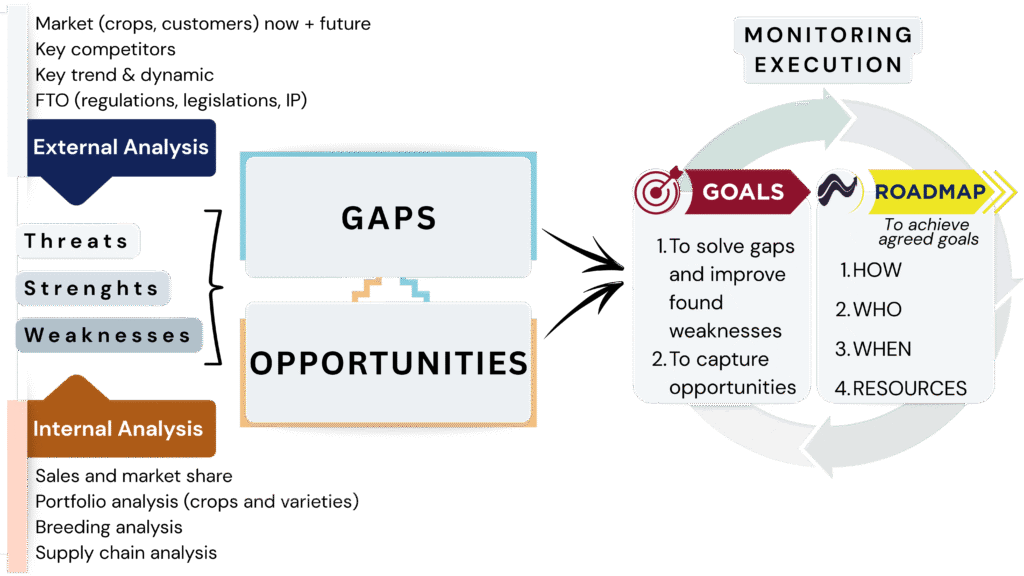
Once opportunities are identified, a differentiated position needs to be created within that space. That requires a focused pipeline, based on essential data such as: field and post-harvest performance stats, USP identification and fast product launch.
In that sense, market research is the foundation not only of crop choice, but also of product positioning, launch strategy, and price realization. In a robust CBP, insights are managed and transformed from market control rods into choices: which PMCs deserve investment, which should be deprioritized, which customer needs should guide product development, where resources should be concentrated, and what capabilities need to be strengthened. Tools such as SWOT and MABA should always be embedded into the CBP.
From there, the Crop Business Plan becomes practical.
Goals are defined. A roadmap is written. Responsibilities, timing and resource needs are clarified.
Companies that do this well are better able to anticipate change, focus resources on the right opportunities, strengthen product positioning and compete more effectively over the medium term. In a sector where development cycles are long but market dynamics move quickly, the winners are not simply those with more ideas, but those that are better apt at converting them into action.