
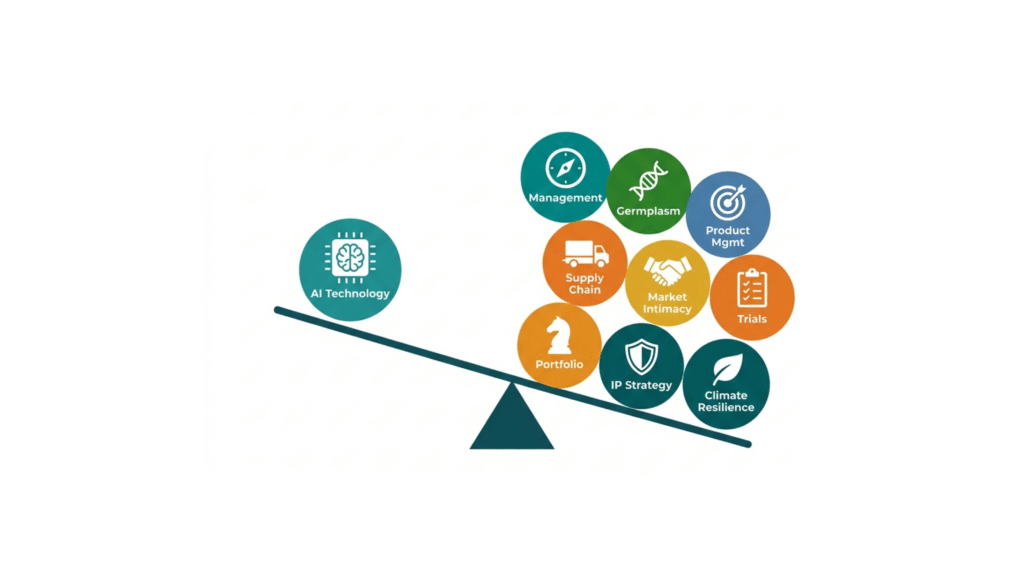
Today, a mid-sized vegetable seed company can acquire an AI platform and connect it to its genomic and trial databases. Suddenly it gains the knowledge and power needed to compress breeding cycles by half, identify winning varieties before competitors, effectively leapfrogging into market leadership.
And yet, when you sit across the table from a CEO who has actually led a vegetable seed business through a decade of market consolidation, the conversation invariably returns to the same fundamentals: germplasm depth, breeding discipline, product management rigor, supply chain reliability, and mostly, an intimate understanding of what growers, traders, retailers and consumers actually need at the end of the day.
The reason is pretty straightforward. Leadership in vegetable seeds is built on a multitude of factors and capabilities, each of which must function at a level competitors cannot (or rather, should not be able to) easily replicate. A company with outstanding genetics but chaotic seed production will lose shelf space to a competitor whose varieties are merely good but reliably available. A company with cutting-edge AI phenotyping but no structured trials network will produce algorithmically impressive outputs that no one in the commercial organization trusts enough to act on.
The aim of today’s article is to revisit the key success factors that define leadership in the vegetable seed industry, examine how they interact and try answering the following questions: where does artificial intelligence actually strengthen these factors? Where does it merely create the illusion of progress?
The Success Factors That Decide Who Leads
Leadership in vegetable seeds rests on a specific cluster of capabilities, which are all well understood by anyone who has operated inside this industry for long enough.
- Stable and experienced management
Vegetable breeding requires patient capital and strategic consistency over timeframes that punish short-termism. A new variety can take six to twelve years to develop. R&D investment typically runs between fifteen and twenty-five percent of turnover. Companies that change strategic direction every time a new CEO arrives, or that cut breeding budgets during cyclical downturns, systematically destroy the long-cycle value their programs were designed to create.
- Deep proprietary and locally adapted germplasm
Wide, highly differentiated germplasm pools allow a company to combine global breeding capabilities with regional adaptation. This is gained through decades of collected, evaluated and strategically curated custom-made data.
- Access to breeding technologies
Genomic selection, digital phenotyping, AI-assisted data platforms, etc.. These all have moved from a desirable advantage to a competitive requirement. Precision breeding tools are no longer the preserve of the top multinationals. They are increasingly available as modular services, cloud platforms, and licensed technologies. A company can gain access to these tools, but must check whether it has the organizational maturity to use them inside a coherent breeding strategy and not keep it as isolated tech.
- Experienced product management
This is where many companies reveal the gap between their R&D ambitions and their commercial execution. Product management is the discipline of deciding which traits matter, in which markets, with which positioning and critically when to stop investing in varieties that will never justify their development cost. In our experience, more value is destroyed in seed companies by the inability to give the kill order to projects than by any deficiency in breeding technology.
- Efficient supply chain execution
It has become, if anything, more decisive over the past years. When a distributor commits shelf space based on a variety’s promise, and the seed shipment arrives two weeks after the planting window closes, the consequence (apart from the logistics inconvenience per se) is a commercial relationship lost, sometimes irreversibly. Seed production, processing, phytosanitary compliance, timely availability, consistent seed quality, etc… these cannot be treated as glamorous topics.
- Disciplined trials network + rigorous data collection
Multi-location trials combined with standardized scoring protocols and digital analytics are not merely validation exercises to confirm whether a variety is ready for launch. They are the company’s primary source of market intelligence, revealing how varieties perform under real conditions, how growers react to them, showing where the competitive gaps are.
- Value-chain intimacy
Deep, continuous relationships with growers, nurseries, distributors, traders, fresh-cut operators, foodservice companies, retailers; this is what allows a seed company to understand demand before it becomes obvious. The companies that understood, years before competitors, that European retailers would demand residue-reduction claims were the ones with the commercial teams that spent enough time in procurement meetings and packhouse loading bays to register and prepare for what was coming.
- Portfolio discipline
Choose the battles that you can win. Although, it is not exactly as easy as it sounds. In practice, it requires the organizational courage to concentrate resources on priority crops and market segments rather than spreading investment across every opportunity that looks plausible on a slide deck. It also requires the willingness to exit categories where the company lacks the germplasm depth, the market access, or the breeding speed to compete credibly.
- IP and proprietary product strategy
The ISF’s 2026–2030 priorities explicitly include intellectual property rights, access to genetic resources, science-based regulatory policy, and free movement of seed. Companies that fail to build robust PVP, PBR, UPOV and Nagoya/ ABS compliance frameworks expose themselves to strategic risks that no amount of breeding excellence can compensate for.
- Climate resilience and disease resistance
Varieties must address all sorts of problems: heat tolerance, drought performance, salinity, emerging virus pressures, reduced chemical input requirements, as well as the practical constraints of labor scarcity.
Where does AI lie in this context?
Where AI Fits
While artificial intelligence excels at compressing analytical effort, competitive leadership in vegetable seeds remains fundamentally interpretive. Essentially, AI is useful in removing avoidable friction from processes that consume expensive technical time without requiring senior judgment at every step.
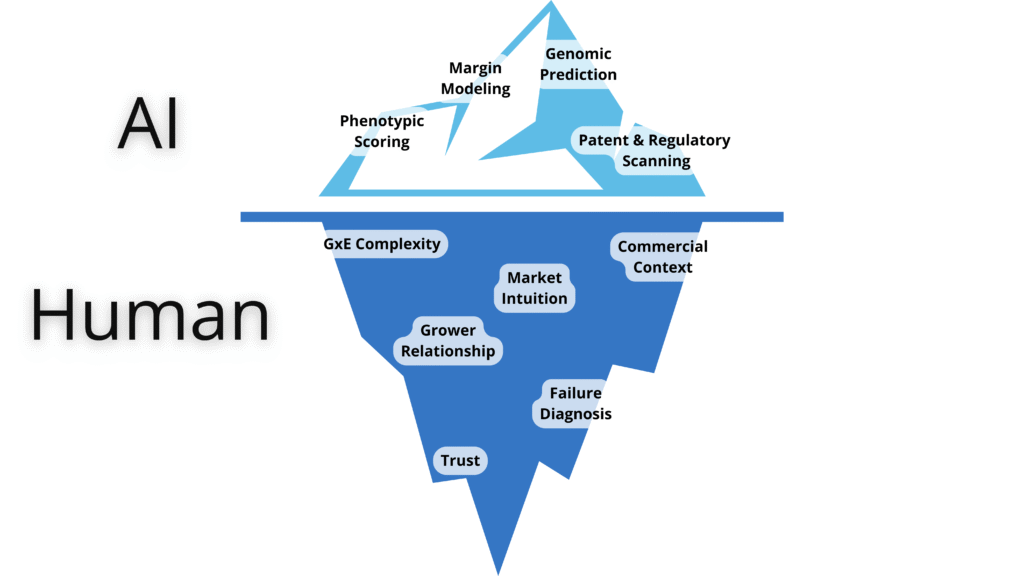
Genomic prediction models can evaluate thousands of potential crosses before committing greenhouse space, accelerating the early stages of genetic gain. Computer vision applied to trial plot imagery can standardize phenotypic scoring across locations, reducing the variability introduced by different human scorers. Natural language processing can scan patent databases, competitor variety registrations and regulatory filings faster than any team of analysts. Statistical models can predict how a variety’s margin shifts if seed production yields drop or if a competitor enters a target segment within minutes rather than weeks.
However, vegetable breeding operates in biologically volatile and commercially nuanced micro-markets.
Consider the reality of internal data discipline within most mid-sized seed companies. While automated weather stations and digital scales record quantitative parameters, the critical commercial context cannot be attached to an Excel sheet. Why did a promising salad tomato line lose distributor support in southern Italy? The answer is frequently locked in a WhatsApp message between a regional sales manager and a grower, a quick margin negotiation in a distributor’s warehouse or a breeder’s mental note about post-harvest softness after four days in a transit depot. When AI attempts to mine chaotic internal memory, it inevitably privileges what happened to be logged over what actually decided the commercial outcome.
This challenge is magnified by the biology of genotype-by-environment-by-management interactions. A winter cucumber bred for low-light unheated plastic tunnels in Sicily operates under entirely different biological stress than one bred for high-wire, artificially lighted glasshouses in the Netherlands. Algorithmic models can detect correlations between temperature logs and plant growth, but they cannot evaluate the subtle agronomic compromises a grower makes when energy costs spike or irrigation salinity fluctuates.
More critically, commercial failure in vegetable seeds is notoriously ambiguous. When a variety fails to gain traction during its introductory year, the raw numbers show weak sales volume. Yet the numbers alone do not disclose causation. Did the variety fail because its resistance package broke under early downy mildew pressure? Or did it fail because seed production arrived two weeks late for the planting window, forcing distributors to stock a competitor’s seed?
If the query is poorly framed, an analytical model can penalize the genetics for an operational failure in supply chain execution. Hence, AI cannot replace the product manager who understands, from years of market experience, that a technically superior variety will fail commercially because its harvest window conflicts with a region’s labor availability, nor it can replicate the trust that a sales representative builds with a distributor over fifteen years of reliable advice.
A company with undisciplined portfolio management will not be rescued by better data analytics, nor will it close the gap through AI-driven variety recommendations if it’s weak in its value-chain relationships.
The seduction is to believe that computational sophistication can compensate for weaknesses in these foundational areas. Rest assured, it cannot.
The Real Competitive Divide
The vegetable seed companies that will lead over the next decade will not be distinguishable by whether they use AI. Almost everyone is using AI in some form, probably even now, to read and summarize the content of this same article. The distinguishing factor will be whether they have the underlying success factors firmly in place before they layer computational tools on top.
AI amplifies whatever strategic condition it encounters. Applied to a well-structured breeding program with disciplined data collection, clear target product profiles and experienced product management, it accelerates decisions and sharpens competitive positioning. Applied to a fragmented organization with inconsistent data, unclear strategic priorities, and product management by committee, it just accelerates confusion.That said, before asking “What AI platform should we invest in?”, you should probably investigate whether your management team has the strategic stability to sustain a twelve-year breeding investment, or if your trials network generates actual market intelligence or merely validates what the breeding team already believes.
If the answer to these questions is yes, AI will make you faster and sharper. If the answer is no, AI will make you faster at the things that are not working.