
by József Mozsár
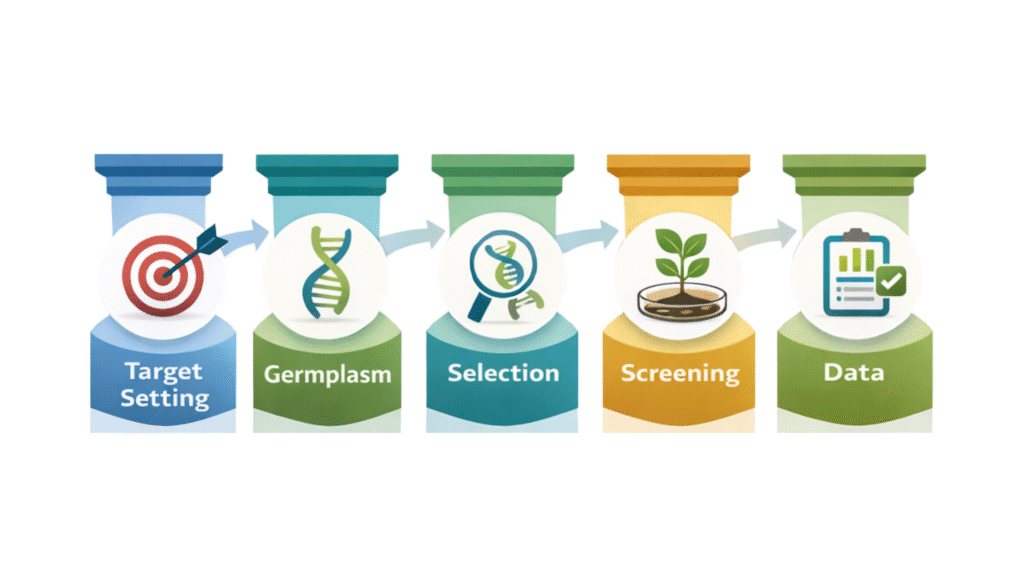
To achieve rapid and sustainable development of competitive new varieties, five foundational pillars must be firmly established:
1. Target Setting – Strategic Market-Driven Target Definition
Define a clear, market-driven target product profile jointly aligned between Sales & Marketing (S&M) and Research & Development (R&D).
The profile must anticipate medium and long-term market trends to ensure strategic consistency and directional focus in breeding efforts.
A well-defined target profile provides decisive guidance for breeding priorities, aligns cross-functional stakeholders, and channels investments toward the most attractive and sustainable market opportunities.
2. Germplasm – Robust and Diversified Germplasm Foundation
Build and maintain a robust germplasm base characterized by sufficient genetic diversity and comprehensive representation of key traits.
While modern genomic technologies accelerate the accumulation of favorable alleles, they may inadvertently reduce genetic variability over time. To safeguard long-term innovation capacity, germplasm pools must be consistently enriched with novel and strategically selected genetic resources, including landraces, genebank accessions, elite commercial varieties, and induced mutants.
Maintaining a balanced structure across early-generation populations, advanced breeding material, and fixed lines ensures both immediate performance gains and long-term resilience.
3. Selection – High-Efficiency Selection for Maximum Genetic Gain
Maximize genetic gain per unit of time and investment by optimizing selection accuracy, applying appropriate selection intensity, and working with sufficiently large population sizes while reducing generation intervals.
Implement preselection to eliminate low-value material early, optimizing the use of available resources.
Accelerated line fixation shortens time-to-market and converts genetic progress into commercial value more rapidly. Technologies such as doubled haploids (DH), marker-assisted selection (MAS), and multiple breeding cycles per year significantly enhance throughput and competitive positioning.
4. Screening – Rigorous Multi-Environment Performance Validation
Evaluate breeding candidates through well-designed, multi-environment trials to ensure performance stability and market relevance.
Cost-efficient cultivation systems and streamlined data collection enable evaluation of larger candidate sets, thereby increasing the probability of identifying superior varieties.
Integration of molecular marker data and predictive modeling further strengthens candidate selection.
Models that combine phenotypic, genotypic, environmental, and agronomic datasets support not only more accurate selection decisions but also improved product positioning beyond trial environments.
5. Data – Data Excellence and Evidence-Based Decision Making
Systematically collect, manage, and analyze high-quality data throughout the entire process.
High-throughput phenotyping improves both precision and efficiency of data acquisition.
Advanced statistical and biometrical analyses enable objective, evidence-based decision-making.
An integrated dataset encompassing phenotypic, genotypic, and environmental information forms the backbone of reliable predictive models, accelerating genetic progress and increasing the success rate of new variety introduction.