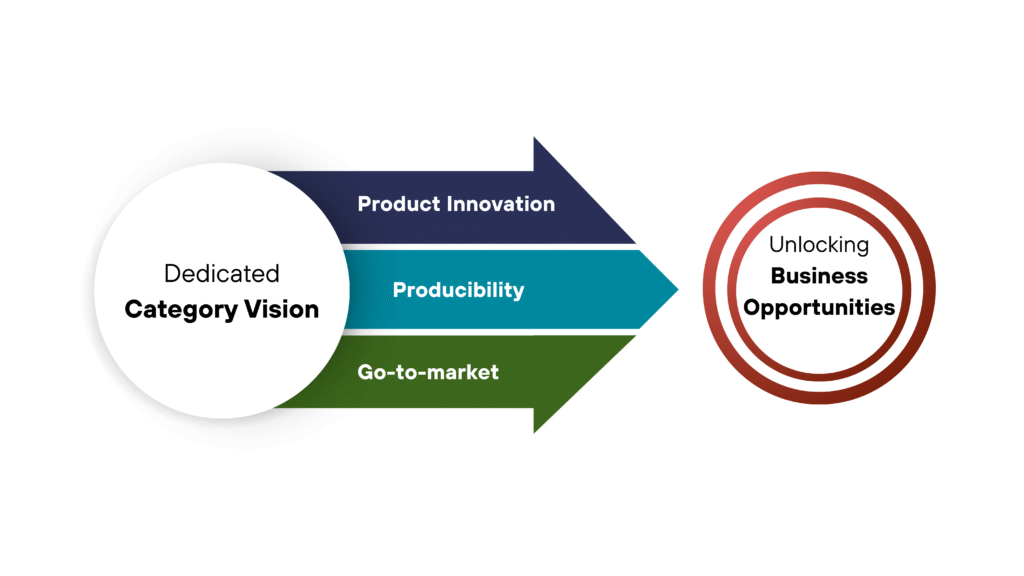
In an industry shaped by climate change, regulation, and shifting consumer values, anticipating consumer demand is a true competitive key. Flavor, convenience, affordability, pesticide free and health benefits remain the primary drivers. However, today success is also dependent on the strategic alignment between product innovation and the farmer’s producibility, in response to shifting lifestyles and consumer preferences.
What a Category Vision really is — and isn’t
Formally, a Category Vision is defined as a data-driven investigation that sets out a strategic roadmap by dissecting and translating market trends and operational hurdles into incremental growth to a specific category, typically detailing how its performance can be step-changed in a potential, near future scenario.

In essence, it’s a simple equation: Vision = Foresight + Execution.
It’s a strategy grounded in trends (consumption & production) analysis and supported by an “out-of-the-box” thinking that best identifies untapped growth opportunities.
A practical, actionable vision is one that:
- reads market trends and translates them into coherent, varietal development plans and go-to-market strategies;
- activates the market with the right product, pack/format, price, and channel;
- enables predictable, resilient, and sustainable growth.
While a Category Strategy optimizes within the existing market rules, a Category Vision dares to redefine them. It aligns cross-functional teams — from breeding, up to marketing and sales — behind one shared view of the future.
Easy to say (write). Harder to do.
Over the years, we’ve seen a few recurring misconceptions about what Category Vision really means. Let’s clarify some doubts, shall we?

Demystifying Category Vision
#1 “It’s only for large corporates.”
Not true.
Size isn’t the barrier. Mindset is.
Smaller and mid-sized agribusinesses often gain the most from a Category Vision because it focuses on limited resources where they matter most. The process forces prioritization, helping teams see which opportunities are truly scalable and which are distractions.
We’ve seen companies discover that the very act of developing a Vision creates an environment of strategic readiness — aligning teams and giving structure to people’s perspectives on the company’s criticalities.
#2 “It’s the job of Product Managers.”
Wrong again.
A Category Vision works best when it’s cross-functional.
It’s not a marketing plan: it’s a management lens. Breeders, product developers, sales leads, and supply-chain experts all have a stake in how the category will evolve, since each sector has its own.
In agribusiness, this integration is critical: flavor, convenience, affordability, and health benefits remain the key drivers of consumer demand — but they can only be delivered through coordinated action across the value chain, for instance where production & supply play a pivotal role.
#3 “It’s theoretical and expensive.”
Perhaps the biggest fear surrounding this topic.
One of the core functions of the Category Vision, is to create an actionable plan, which is based on theoretical data and the team’s expertise. A Category Vision serves best its purpose when it’s treated as a living tool: updated with new data, used to test scenarios, referenced in investment choices.
A strong Vision doesn’t stay in a binder: it lives on the boardroom.

When to use it
A Category Vision becomes essential when past experience is no longer sufficient to efficiently predict future performance. That moment could be triggered by:
- A shift in consumption patterns (e.g. health-driven choices, snacking, local sourcing);
- Rising production volatility due to climate or labor constraints;
- New competitive pressure or channel fragmentation.